How to Outline a Novel You'll Actually Finish
The outlining debate is the oldest argument in writing that produces nothing. Plotters insist a map saves you from the swamp; discovery writers insist a map kills the reason for walking. Both camps are right about their own drafts and wrong about yours, which is why the useful question is not whether to outline but what kind of outline your particular story needs, and how much of it needs to exist before chapter one goes live.
Serialized fiction sharpens this further, because a serial punishes bad planning differently than print does. A print novel with a saggy middle gets revised before anyone sees it. A serial with a saggy middle loses readers in public, in real time, at chapter eleven. But a serial also forgives differently: readers arrive mid-stream all the time, and a strong week can rebuild what a weak month cost. The outline a serial needs is not a prison blueprint. It is closer to a spine with gaps, a set of load-bearing points you are certain about, connected by territory you are willing to discover in public.
What an Outline Actually Buys You
Forget "organization." An outline buys three concrete things, and judging it by anything else is why so many outlines get abandoned by chapter five.
First, it buys recovery speed. Every serial writer eventually loses the thread, because life intervenes mid-arc. The writer who knows the next three tentpoles can resume in an afternoon. The writer who was improvising has to reread sixty thousand words of their own work to remember what they promised. Second, it buys foreshadowing for free: you can only plant the gun in chapter three if you know it fires in chapter thirty, and plants are the single cheapest way to make a serial feel "planned" to readers. Third, it buys permission to improvise safely, which is the part nobody mentions. A writer who knows four fixed points can wander freely between them. Discovery between tentpoles is still discovery.
What an outline does not buy: quality, speed, or an ending you have not actually imagined. An outline that exists to avoid writing is a form of procrastination with a table of contents.
Four Ways Serial Writers Actually Outline
The milestone outline. You fix only the events the story cannot skip: the inciting incident, the midpoint turn, the low point, the climax. Four to eight bullet points for an entire book. Everything between them is discovered at the keyboard. This is the minimum viable outline, and it suits writers whose failure mode is wandering, not freezing.
The arc-sheet outline. You outline by movements rather than chapters: arc one is the character's wound getting poked, arc two is the price of the first victory, arc three is the mask coming off. Each arc gets a one-paragraph premise and a terminal image. Chapters are left to emerge inside each arc. This suits serials especially, because arcs align naturally with the "release block" cadence readers already experience.
The chapter-plan outline. A line per chapter, scene by scene, the full spreadsheet. Maximum control, maximum brittleness. It suits short serials, mysteries with planted clues, and any story where a missed plant breaks the machinery. Its known failure is that the writer gets bored of their own story, having already "told" it once in the outline.
The discovery outline. No map, but rules: a known ending, a known voice, a known cast, and the discipline to stop each session with tomorrow's scene slightly planned. This is a real method, not the absence of one. Its cost is structural: you will rewrite more, and in a serial that rewriting happens in public.
Choosing between them is less mystical than the discourse suggests. Match the method to the problem you actually have. If your drafts die in the middle because you forgot where they were going, use the milestone spine. If your chapters individually work but the book feels episodic, you need the arc sheet. If you are writing a mystery or a thriller where a missed clue breaks the machinery, you need the chapter plan, because plants cannot be retrofitted gracefully. And if every outline you have ever written died of boredom, stop fighting the discovery method and give it the two things it actually requires: a known ending and the habit of planning tomorrow's scene at the end of today's session.
Six Serials Whose Structure You Can Watch Working
Method talk is cheap. These six serials each visibly run on a different structural engine, and you can open any of them and watch the machinery work in the actual chapters. Ordered by reading time, longest first. All are free on NovelDay.
1. I Swear I Saw You Die [Vol 3 Complete]
The engine: the volume outline.

This is the engine the others cannot teach, because it only exists at serial scale: the outline drawn in volumes instead of arcs. Three volumes in, each one is a self-contained campaign with its own spine, its own escalation, and its own exit. Tim's immortality, his daughter Mia, and the assassin who shatters their arrangement are not introduced as ingredients of one endless middle; each volume takes the arrangement apart in a different way and rebuilds it somewhere harder. That is what a volume outline buys a serial writer: you do not need two hundred planned chapters, you need three planned volumes and the discipline to let each one end. If your serial keeps sagging in the long middle because no arc ever gets permission to actually conclude, this is the structure to study.
Read I Swear I Saw You Die [Vol 3 Complete] on NovelDay
2. The Sky That Lied
The engine: a character-spine outline.

Open chapter one and watch what the outline was probably built around: not events, but a boy carving stars into a wall because the sky over his city is controlled by people above him, while his sister watches from the pallet. The scene is almost plotless. What it installs instead is a want (light, air, the space above the shacks) and a cost already being paid (split knuckles, no money for candlelight). A character-spine outline does not ask "what happens next"; it asks "what does the protagonist reach for next, and who pays for it." Every chapter of this serial answers the second question. If your draft keeps drifting because events arrive without emotional logic, this is the engine to study: the plot is whatever the wanting produces.
Read The Sky That Lied on NovelDay
3. New Game [LITRPG]
The engine: the milestone outline that LitRPG hands you for free.
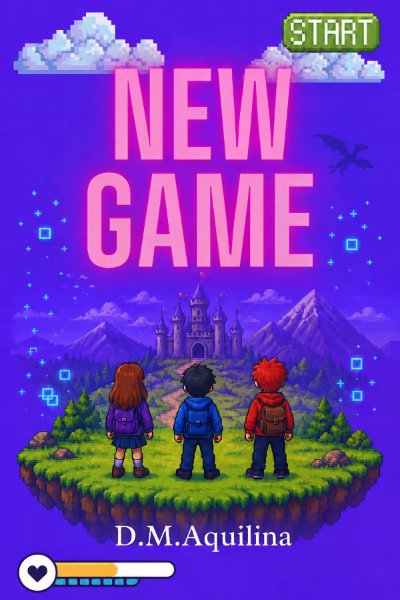
Three friends sign up for a beta test that turns out to be much more than VR, and then the genre itself takes over the scaffolding: levels to climb, abilities to test, a world whose rules get discovered one system at a time. This is the quiet structural gift of progression fiction. The reader already knows the shape of the road (grow, test, hit a wall, grow past it), so the outline's job shifts from inventing milestones to choosing which milestones deserve chapters. If you write in a game-shaped genre, you are not outline-free; you are working from a template the audience already holds. The craft is in the selection, not the invention.
Read New Game [LITRPG] on NovelDay
4. The Chronicles of Veledan - The Silver Dragon
The engine: the braid.

Chapter one announces its architecture in the heading itself: "POV Moritz," followed by a disciplined character running his morning routine inside a fortress that clearly has opinions about him. A multi-POV epic cannot be discovery-written without collapse, because every braid crossing has to be scheduled. The outline for a book like this is less a line than a lattice: thread A advances while thread B waits at its cliffhanger, and the reader's impatience with the pause is part of the engine. If your story needs more than one pair of eyes, this serial is the case study for how to keep each thread alive in the reader's memory while the others run.
Read The Chronicles of Veledan - The Silver Dragon on NovelDay
5. Welcome Traveler
The engine: declared discovery.

The author's note ahead of chapter one deserves quoting because it is the most honest outline statement in the catalog: "a pile of questionable notes... This is my first serial fiction. I have no idea where exactly this will go." And then the chapter delivers anyway: a tolling bell, a mushroom-lit world, prose that keeps stopping to look at things ("mushrooms pulsing like an odd fungal heartbeat"). This is the discovery method with its seams showing, and it survives because the author gave the reader a different contract: not "I have a plan" but "come see where this goes." If you cannot outline, the honest version is to admit it and make the wandering itself the point of the ride.
Read Welcome Traveler on NovelDay
6. The Killer's Consultant [Kdrama Crime Thriller]
The engine: the genre form is the outline.

Crime procedurals arrive with their outline pre-installed: the body, the consultant who sees what police cannot, the evidence trail, the red herring, the reveal that reframes the room. The Killer's Consultant runs exactly that skeleton — a detective who keeps consulting a charming killer for insight into other killers — and the chapter-one interest is not the shape but the seam work: what the writer hangs on the case-of-the-week scaffold, how the consulting relationship is itself the slow-burn arc between episodic cases. When your premise carries a known form (heist, tournament, voyage, investigation), the cheapest outline available is the genre's own skeleton, and the craft moves entirely to the characters, the tension, and the seams.
Read The Killer's Consultant [Kdrama Crime Thriller] on NovelDay
A Template That Works for Serials
Most novel-outline templates assume a book written in private then shipped whole. Serials need something shaped like the release schedule. A working serial outline has three layers, and only the first is mandatory before you publish:
- The spine (before chapter one): the story question in one sentence, the ending image in another, and four to eight tentpole events between them. If you cannot name the ending image, you are not outlining, you are hoping.
- The current arc sheet (rolling, always one arc ahead): for the arc in progress only, a line per chapter. Chapter plans rot if you write them too early, because characters renegotiate as you go. Keep exactly one arc of detail ahead of the public.
- The buffer (practical, not artistic): a count of drafted-but-unpublished chapters. Zero is a valid answer but it means your outline's real job is keeping panic from producing plot decisions. Most serial disasters happen when the buffer hits empty mid-arc.
That is the whole template. Spine, current arc, buffer count. Everything else (beat sheets, color-coded act boards, save-the-cat grids) is decoration on those three layers, useful only to the writer it helps.
Here is what it looks like filled in for a hypothetical serial. Spine: "A disgraced cartographer maps the city that erased her, and the map starts mapping back." Ending image: she redraws the last district with her own name on it. Tentpoles: she loses her license; she discovers a street that should not exist; the city's official map declares her a fraud; she learns the map is a person; she chooses the city over the guild that exiled her. Current arc sheet, arc one only: chapter one, fired in front of the cartographers' guild; chapter two, a client pays in foreign coins for a street nobody else can find; chapter three, she walks it and it rearranges behind her; chapter four, first map sold, first warning received. Buffer: six chapters drafted, zero published. A writer holding that sheet knows exactly what they owe next Friday, and equally important, what they are free to invent between now and then. The invented part is where serials stay alive.
One more thing the template deliberately leaves out: foreshadowing notes live on the arc sheet, not the spine. When the coins in chapter two need to matter again in chapter nineteen, the note belongs next to the chapter where it pays off, not in the spine where it would have been forgotten. Plants written into the plan get planted; plants remembered fondly get missed.
Related Craft Decisions
An outline tells you what happens; chapter one decides whether anyone sees chapter two. Our first-chapter guide covers that opening move. If the thing you keep outlining is the world rather than the plot, the serial worldbuilding post is about building between the chapters instead of ahead of them. And once the outline exists, the chapter-length data is worth a look before you decide how big each box should be.
Questions Writers Ask About Outlines
Do I have to outline a novel before writing it? No. Welcome Traveler runs openly on a pile of questionable notes, and it works because the author made the wandering the contract. But even discovery writers benefit from a spine: the ending image and the story question. You can improvise the road. You cannot improvise the destination without eventually looking lost.
How detailed should a novel outline be? Detailed enough that a two-week break does not strand you, and flexible enough that a better idea in chapter nine does not wreck the plan. For most serials that means tentpoles fixed, current arc planned chapter by chapter, everything after that deliberately vague.
What is the best outlining method? Whichever one matches your failure mode. Writers who stall need more outline; writers who get bored need less; writers who lose the thread need the arc sheet specifically, because it is the only layer you will actually reread. The method is a tool for your known weakness, not a personality type.
How do you outline a web serial differently from a novel? Two ways. You plan in arcs that align with release rhythm rather than acts that align with page count, and you maintain a buffer, because the audience is reading in the room while you build. A print outline can afford to be finished early; a serial outline only ever needs to stay ahead.
Does outlining kill spontaneity? Only if you write the wrong layer early. A fixed spine leaves all the discovery between the tentpoles, which is where the good surprises happen anyway. The writers who feel caged by outlines usually outlined scenes instead of events, and discovered that scene-level plans are where the joy lives.
Where can I publish a serial while I figure out my outline? Chapter-by-chapter publishing is itself an outline teacher, because reader reaction tells you which turns landed. On NovelDay you can publish free, keep every right, and start finding out which method is yours.
The Honest Answer
Outline as much as your failure mode requires and not one scene more. The six serials above prove the range: one runs on volume-sized arcs, one on a character's wanting, one on the genre's milestones, one on a scheduled braid of viewpoints, one on a form that came pre-built, and one on an author openly admitting there is no map. None of those is the correct choice in the abstract. The correct choice is the smallest structure that keeps your specific story from collapsing in public.
If you want to study these engines in the wild, all six serials are free in the NovelDay library. And if you are still deciding how much map your own story needs, the cheapest experiment is to publish the first chapters and watch where your own certainty runs out. novelday.net/write is free, and the rights stay yours either way.